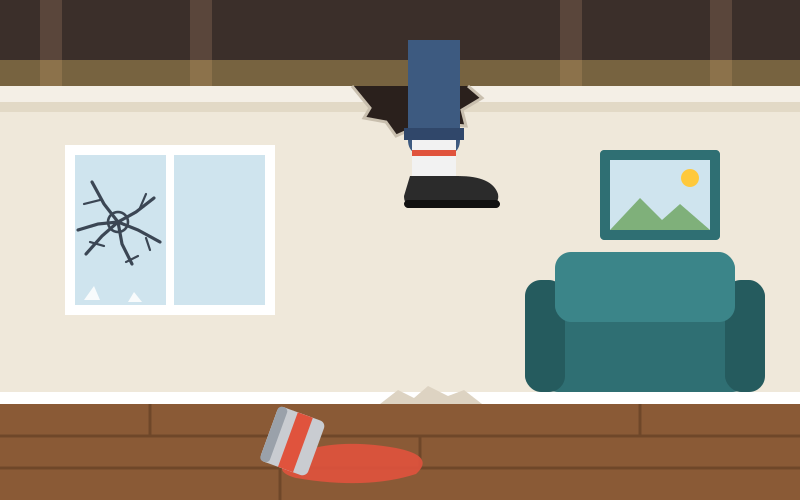
A foot through the ceiling, a dropped TV, a smashed window or a tin of paint across the carpet. Accidents happen in every home, but accidental damage claims are full of small print, so it pays to get yours right from the start.
Accidental damage means sudden, unexpected and visible damage that wasn't done on purpose. It can be damage to the building itself, or to your belongings, and a small accident can lead to a surprisingly large repair bill.
Slipping off the joists in the loft and putting a foot or leg through the ceiling below.
A smashed window, glass door, mirror or glass table, or a cracked ceramic hob.
Paint, wine or nail varnish on a carpet, or drilling through a pipe or cable.
A TV knocked off its stand, a laptop dropped, or furniture damaged in a fall.
A car, van or falling object hitting your home, wall or extension.
Accidental damage is one of the most misunderstood parts of a home insurance policy. Many refusals come down to the wording, and some of them can be challenged.
On many policies, full accidental damage cover is an optional extra. Even without it, most buildings policies still cover some accidents as standard, such as broken fixed glass, sanitaryware and damage to underground pipes and cables. We check exactly what yours includes.
Insurers may say the damage built up gradually, or that something simply wore out. Accidental damage has to be sudden, so the timing and the evidence matter. We challenge this where the facts point to an accident.
Many policies exclude damage caused by pets, and damage from faulty workmanship or badly done DIY. The exact wording matters, and it isn't always as wide as the insurer suggests.
Accidental damage often has its own excess, and some items have a single-item limit. Make sure the claim is worked out on the right figures.
Electrical or mechanical breakdown, such as a TV that stops working on its own, usually isn't covered as accidental damage. A TV that's knocked over and smashed usually is.
On a larger accidental damage claim your insurer may send a loss adjuster or a surveyor. They work for the insurer. A loss assessor works for you, checks the policy wording for every bit of cover you have, and makes sure the full cost of putting things right is included.
I spent 10 years adjusting claims for insurers, and 36 years in claims in all, so I know how an accidental damage claim is looked at from the other side of the table. Our review of your claim is free and without obligation. If we take it on, our standard fee is 10% plus VAT of the agreed settlement, and there's no fee at all on building repairs if you use Sarrani. See our fees.
You make one call. We do the hard part in between.
Call or email and tell us what happened. Steve will tell you straight what your claim could be worth and what to do next.
We prepare the evidence, deal with the loss adjuster, and handle every letter and meeting. If you want, Sarrani manages the repairs too.
We negotiate until your claim is settled fairly. You're copied into every important email and report along the way.
Often, yes, if your buildings insurance includes accidental damage. Without that extra cover it may not be. The repair usually means re-plastering and redecorating the ceiling, and sometimes more if wiring or insulation was damaged.
Many buildings policies cover accidental breakage of fixed glass, such as windows and glass doors, as standard, even without full accidental damage cover. Check your policy, or send it to us and we'll check it for you.
Spills are a common accidental damage claim on contents insurance, but usually only if you have accidental damage cover. Some insurers will clean rather than replace, so the evidence of the damage matters.
Many policies exclude damage caused by pets, but not all of them, and some only exclude certain kinds of pet damage. We read the exact wording before you accept a refusal.
Impact by a vehicle is usually covered under the buildings section of your policy, whether or not you have accidental damage cover. Your insurer may then try to recover its costs from the driver's insurer.
Talk to an expert, not a call centre. Tell us your story and we'll tell you how we can help.